
Why Heater Choice Can Make or Break Your Test Data
When you’re designing a test or validation setup, it’s easy to treat the heater like just another line item—pick a wattage, check the temperature rating, and move on. But heater technology itself can make a noticeable difference in how your system behaves: response time, thermal uniformity, control accuracy, reliability, and ultimately the credibility of the data you’re collecting.
Different testing environments place very different demands on the heating system. A thermal cycling rig that needs aggressive ramps is not the same as an environmental chamber where you’re chasing ±0.5 °C uniformity across dozens of sensors. The most successful test setups treat heater selection as an engineering decision early in the design process, not as a late-stage component substitution when the chamber won’t meet spec. 
Why Heater Selection Matters
As an engineer, you know when test results start looking inconsistent, the blame usually falls on sensors, control algorithms, software, airflow, or chamber design. Those are common culprits—but very often, the heating system itself is quietly driving more of the behavior than expected.
Heater technology influences almost every aspect of thermal performance: how quickly your setup reaches temperature, how evenly heat is distributed, how tightly you can hold a setpoint, and how repeatable your profiles are from cycle to cycle. A heater that works beautifully in a tightly clamped platen may create hot spots and gradients when dropped into an environmental chamber, even if the power rating looks identical on paper.
For example, a high‑watt‑density cartridge heater can be exactly what you need for rapid thermal cycling of a test fixture—but the same approach in a chamber wall can drive steep local gradients and overshoot near nearby sensors. Likewise, a heater optimized for uniform surface heating might deliver excellent flatness on a plate but struggle to hit aggressive ramp rates in a dynamic test.
Two heaters with identical power ratings can behave very differently depending on:
- Heater geometry
- Watt‑density distribution
- Heat transfer characteristics
- Sensor placement
- Airflow design
- Control strategy
That’s why heater selection should be treated as a system-level engineering decision rather than a simple component substitution. The goal isn’t just “generate heat.” The goal is “generate the right heat, in the right place, at the right rate,” while maintaining the level of control and consistency your test method requires.
Choosing appropriate heater technology early in the design can improve test accuracy, reduce troubleshooting, minimize redesign cycles, and increase confidence in the data you present to your team or customers. At Backer Hotwatt, we look beyond generic temperature ranges, and collaborate with engineers and test equipment manufacturers to design thermal solutions that support specific testing objectives and performance requirements.
Cartridge Heaters
Cartridge heaters are a go-to solution when you need high watt density, fast response, and precise localized heating inside a fixture or block.
They’re commonly used in:
- Thermal platens and plates
- Semiconductor and electronics test equipment
- Precision test fixtures
- Laboratory hardware
- Manufacturing validation systems
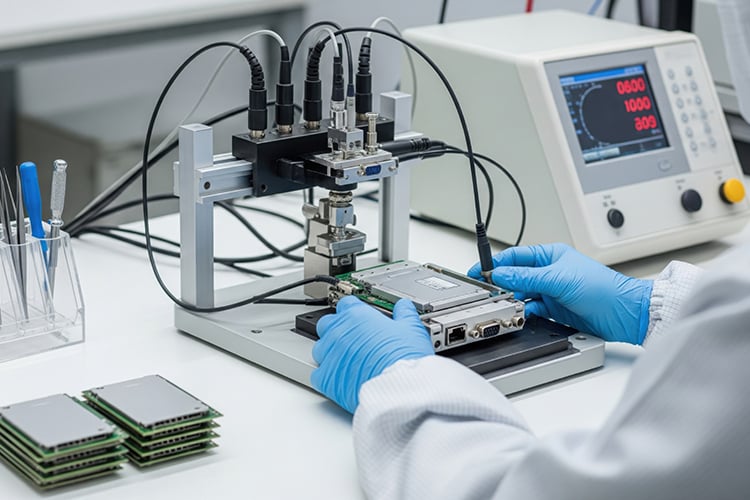
In practice, you might embed high‑watt‑density cartridges into a thermal block that cycles a device under test through rapid temperature steps. You get the ramp rates you need, but success hinges on how you couple the heater to the block, where you place sensors, and how you tune the control loop to avoid overshoot and hotspots near the DUT.
Flexible Silicone Rubber Heaters
Flexible silicone rubber heaters provide excellent surface conformity and uniform heat distribution across complex geometries.
They’re widely used in:
- Battery testing systems
- Environmental chambers
- Medical devices
- Electronics testing rigs
- Analytical instruments
If you’re trying to hold a battery module or panel at a very tight uniformity spec, wrapping the surface with a flexible silicone heater can reduce gradients that show up in your thermocouple grid. The ability to bond or clamp these heaters to irregular shapes, combined with embedded sensing options, makes them especially valuable when installation flexibility and thermal uniformity are key design considerations.
Tubular Heaters
Tubular heaters remain one of the most versatile heating technologies available, especially when you need durable elements that can be formed to follow ducts, tanks, or fixtures.
You’ll see them in:
- Air heating circuits
- Liquid heating loops
- Environmental simulation equipment
- Industrial testing systems
- Process validation rigs
In a test environment, a formed tubular heater might follow the contour of a chamber wall or process line, creating a heating profile that matches your geometry instead of forcing you to redesign the fixture. Their robustness under cycling, vibration, and harsh environments makes them well suited for long-running validation programs where downtime and replacement are major concerns.
Air and Gas Heating Elements
For applications involving controlled airflow, air and gas heating elements are often the preferred solution.
Typical uses include:
- Environmental chambers
- Thermal cycling systems
- Analytical instruments
- Airflow testing setups
- Process simulation systems
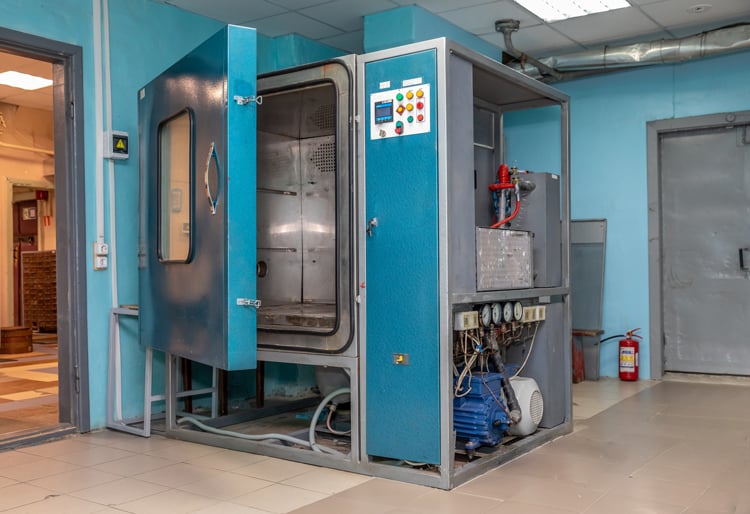
These elements are usually integrated into ducts or manifolds to heat air or gas as it flows past, enabling non‑contact heating of the DUT while maintaining consistent temperature profiles throughout the chamber or test path. Matching element power, airflow rate, and duct geometry is critical here—get that wrong and you’ll see stratification, slow ramps, or unstable control even if the overall wattage looks adequate.
Miniature and Micro‑Cartridge Heaters
As equipment becomes smaller and more sophisticated, thermal management challenges often increase rather than decrease. 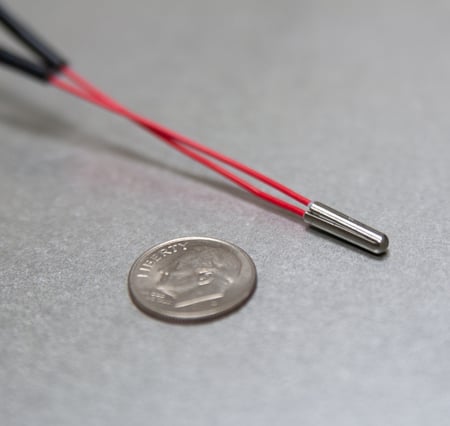
Miniature and micro‑cartridge heaters are commonly used in:
- Scientific and analytical instruments
- Medical diagnostics hardware
- Sensors and sensing modules
- Laboratory instruments
- Compact test and measurement devices
These applications often require precise thermal control within extremely limited space—such as a small calibration block, optical bench, microfluidic channel, or sensor assembly. Here, the heater’s physical size, thermal mass, and proximity to the sensing or reaction region matter just as much as its power rating. A well‑chosen micro‑cartridge heater can provide tight stability without introducing thermal lag that slows response or distorts measurements.
Custom Engineered Heating Assemblies
Many testing applications have thermal requirements that don’t fit neatly into a standard catalog part. In these situations, Backer Hotwatt engineers frequently develop custom heating assemblies that integrate:
- Heating elements
- Sensors
- Controls
- Thermal management strategies
The goal is to create a complete thermal solution optimized for your specific performance requirements. Available space, temperature range, ramp rates, uniformity targets, control accuracy, environmental conditions, safety requirements, and serviceability all influence the final design.
Custom assemblies are often used in battery testing systems, scientific instruments, environmental chambers, semiconductor equipment, medical devices, and other setups where thermal performance directly impacts test accuracy and repeatability. For example, integrating heaters and sensors into a single assembly for a battery validation rig can reduce wiring complexity, improve cell‑to‑cell temperature consistency, and simplify fixture build and maintenance.
By designing the heating system as an integrated part of the overall application—not as a bolt‑on component—you can achieve more precise temperature control, better thermal consistency, and reduce the risk of unexpected performance issues during testing and validation.
How to Determine the Best Heater for a Testing Application
When you’re under schedule pressure, it helps to think about heater selection as a short decision path rather than a long checklist.
- Clarify test objectives.
Are you optimizing primarily for accuracy and uniformity, for ramp speed, or for stressing the DUT with aggressive profiles? Your choice of heater technology will follow that priority. - Define operating envelope.
Nail down required temperature ranges, ramp rates, and stability targets (for example, “±0.5 °C over 30 minutes” or “step changes of 20 °C per minute without overshoot”). - Map physical constraints.
Consider available installation space, geometry, mounting options, and whether the heater needs to be embedded, surface‑mounted, or integrated into airflow or liquid paths. - Assess control and sensing capabilities.
What sensors will you use (thermocouples, RTDs, thermistors)? Where can they be placed? What kind of controller or PLC do you have, and how sophisticated can your control strategy be? - Account for environment and validation requirements.
Think about ambient conditions (humidity, vibration, chemical exposure), safety and compliance needs, and how the setup will be validated and documented.
From there, the best heater is rarely the one that simply generates the most heat. It’s the heater—and heater architecture—that delivers the thermal performance your application actually requires, within your real space, control, and environmental constraints.
A few rule‑of‑thumb examples:
- If your priority is tight surface uniformity across a plate or panel, start by looking at flexible or etched‑foil surface heaters rather than high‑watt‑density cartridges.
- If you need fast, repeated thermal steps in a fixture, higher watt density and lower thermal mass will help—but plan on more careful sensor placement and control tuning to manage overshoot.
The Value of Thermal Engineering Expertise
Successful testing systems depend on more than good components; they depend on solid thermal system design. Understanding how heater technology interacts with geometries, sensors, control loops, airflow, and test objectives can mean the difference between stable, reliable data and chasing unexplained variation during a validation campaign.
In practice, many teams reach out once they’ve already hit a limit: chambers that won’t meet ramp specs, fixtures that show inconsistent readings across sensors, or instruments that drift when cycled through temperature extremes. Getting thermal expertise involved earlier—when you’re still shaping the design—often prevents those issues and reduces the need for late‑stage redesigns.
At Backer Hotwatt, we help engineers develop thermal solutions that support demanding testing and validation applications across a wide range of industries, from semiconductor and electronics to battery systems, scientific instruments, medical devices, and industrial test rigs. If you’re planning a new test setup or troubleshooting an existing one, you can explore our capabilities here or connect with an engineer to talk through your test profile, constraints, and heater options.
FAQs
Q: What is watt density in a heater?
A: Watt density is the amount of power generated per unit area of the heater’s active surface, typically expressed in watts per square inch. It influences how quickly the heater reaches temperature, the operating surface temperature, the likelihood of thermal gradients, and the risk of hot spots that can damage components or shorten heater life.
Q: Why is thermal uniformity important in testing?
A: Thermal uniformity ensures that all test specimens or measurement points experience similar thermal conditions, which improves repeatability and confidence in the data. Poor uniformity can lead to conflicting sensor readings, false failures, or passing parts that may fail later under more consistent temperature exposure.
Q: How does heater response time affect testing?
A: Heater response time affects how quickly you can achieve and change temperatures, which directly impacts ramp rates, recovery times, and thermal cycling performance. Slow or inconsistent response makes it hard to accurately simulate real operating conditions or meet aggressive test profiles without overshoot.
Q: What causes poor temperature control accuracy?
A: Common causes include improper sensor placement, controller tuning that doesn’t match heater dynamics, thermal lag between the heater and the DUT, airflow or insulation issues, and heater geometry or watt‑density limitations. In many systems, rethinking sensor location relative to the heater and heat path improves control accuracy more than simply changing the controller.
Q: How do I select the right heater for a testing application?
A: The best heater choice balances watt density, response time, thermal uniformity, control accuracy, operating environment, and the specific thermal requirements of your test profile. Start by clarifying your test objectives (accuracy vs. speed), then map physical constraints (space, geometry, airflow), and finally match heater technology to those needs rather than defaulting to the highest‑power option available.
Q: When should I prioritize high watt density versus low watt density?
A: High watt density is useful when you need rapid heating or aggressive thermal cycling in limited space, such as a compact fixture or feed zone. Lower watt density is better for sensitive materials, fluids that can scorch or scale, or applications that require gentle, uniform heating over larger areas, such as environmental chambers or battery panels.
Q: How can I improve thermal uniformity in an environmental chamber or test fixture?
A: You can improve uniformity by adjusting heater geometry and placement, optimizing airflow paths, using surface or flexible heaters to smooth gradients, and aligning sensor grids with known hot and cold spots. Collaborating early on heater layout and sensor placement helps avoid chasing uniformity problems with only controller tuning later.
Q: What are typical warning signs that my heater selection is limiting test performance?
A: Common signs include slow ramp rates despite adequate power, persistent temperature gradients across the DUT, overshoot or oscillation during setpoint changes, and frequent heater or component failures near hot spots. If control tuning and sensor changes don’t resolve these issues, it’s often time to revisit heater watt density, geometry, and integration.
Q: Why involve a heater manufacturer early in test system design?
A: Early engagement helps align watt density, geometry, sensor placement, and control strategy with real test requirements before mechanical and electrical constraints are locked in. That reduces redesigns, shortens validation time, and makes it more likely your test system will hit its performance targets in both the lab and the field.